


Reviewed and updated August 16, 2026.
Parota is a large tropical tree known for its broad crown, curved ear-shaped pods, and boldly figured wood. The scientific name used by Mexico’s biodiversity authority CONABIO is Enterolobium cyclocarpum. Across its range, the same species may be called parota, guanacaste, huanacaxtle, nacaxtle, orejón, or other regional names.

This guide explains what a parota tree is, where it grows in Mexico, how to recognize its fruit and seeds, and why the wood appears in furniture. Botany and sourcing are related but not interchangeable: identifying a species does not prove that a particular board was harvested or traded responsibly.
Featured-snippet answer: Parota is *Enterolobium cyclocarpum*, a tropical American tree that grows in Mexico’s warm lowlands. It develops a wide crown, produces curved ear-shaped pods, and yields a figured wood used for carpentry and furniture.
What is a parota tree?
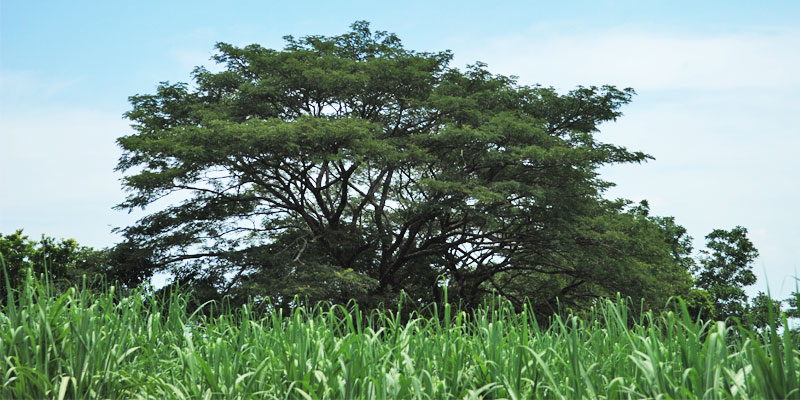
Parota belongs to the legume family. It is deciduous, meaning that it may lose its leaves during part of the dry season. CONABIO describes a large, distinctive tree commonly 20–30 meters tall, with some specimens growing larger, a massive trunk, and a broad hemispherical crown.
That scale is important. A mature parota can provide extensive shade, but it also needs enough space for roots and canopy. Planting decisions should account for buildings, utilities, pavement, wind exposure, soil, water, and long-term maintenance. A regional arborist or forestry professional should evaluate the site.
Where does parota grow in Mexico?
CONABIO identifies *Enterolobium cyclocarpum* as native to Mexico, Central America, and northern South America. In Mexico, it is found along the Gulf side from southern Tamaulipas toward the Yucatán Peninsula and along the Pacific side from Sinaloa to Chiapas. It is primarily associated with warm, low-elevation areas, including coastal zones and sites near rivers and streams.
Trees do not grow identically across that range. Local climate, soil, water, competition, and management affect crown shape, trunk form, and size. A broad geographic distribution should not be turned into a generic planting or harvesting prescription.
Parota, guanacaste, huanacaxtle, and nacaxtle
Common names vary by language and region. CONABIO records parota in parts of Michoacán, Guerrero, and Jalisco, as well as names such as orejón, guanacaste, and huanacaxtle elsewhere in Mexico.
For readers asking “what is parota in English?”, the most precise answer is to retain the common name parota and add the scientific name Enterolobium cyclocarpum. “Elephant-ear tree” and “earpod tree” may appear in English references, but common names can overlap. The scientific name prevents ambiguity when specifying wood or researching the species.
How to recognize the tree
Crown and trunk
Mature trees develop a wide, rounded crown and can have a very large trunk. Buttressing and branch form vary with age and growing conditions.
Leaves and flowers
The leaves are compound and divided into many small leaflets. Clustered flowers precede the fruit. Timing depends on climate and location.
Parota fruit and seeds
The fruit is a curved, flattened pod whose outline resembles an ear—one reason several regional names refer to that shape. The pod contains hard-coated seeds surrounded by fibrous pulp. The seed coat restricts water entry until it is altered, which affects germination.

Traditional food, forage, or medicinal references should not be treated as universal safety advice. Identification and preparation require specialized sources. This article describes the plant and documents broad categories of use without recommending ingestion or treatment.
Ecological and cultural importance
Parota occurs in tropical lowland landscapes, including disturbed or secondary vegetation and some forest associations. A mature crown adds shade and physical structure. Flowers, pods, foliage, and cavities may interact with wildlife, livestock, and people differently from one site to another.
The many local names also show a long cultural relationship with the species. Documented uses include shade, ornament, wood, forage, and regional practices. Context matters: the tree should not be presented as a uniform or unlimited commodity.
What is parota wood like?
Parota wood often shows a strong contrast between lighter sapwood and warmer or darker heartwood, with visible grain and pores. Appearance varies by tree, board, and cut. A finished product depends not only on the species but also on drying, selection, grain orientation, joinery, thickness, base design, and finish.
Before specifying parota wood, review:
- Supplier identity, declared origin, and traceability.
- Moisture content appropriate for the destination.
- Checks, defects, stress, and stability in each board.
- Structural design and base geometry.
- Finish and maintenance plan.
- Indoor, protected outdoor, or direct-exposure conditions.
For a broader material comparison, use the types of wood guide. This keeps general material research separate from the commercial furniture intent.
Responsible sourcing: questions to ask
“Natural wood” does not automatically mean “sustainable wood.” Responsible purchasing needs verifiable information about origin and supplier documentation, plus a design that uses material efficiently and remains serviceable over time.
Ask a supplier or manufacturer:
- What scientific name is declared for the wood?
- What region and supplier did the lot come from?
- What origin or transaction documents accompany it?
- How was it dried, and what is its moisture content at fabrication?
- How will yield be optimized and offcuts used?
- Can the finish be repaired or renewed?
Avoid treating a live edge, a large slab, or the species name itself as proof of sustainability. The claim depends on the supply chain and the product’s full life cycle.
Parota wood in furniture projects
Wide boards and expressive grain make parota a visible choice for dining tables, tops, consoles, doors, and other millwork. Large pieces still require engineering. Wood movement, joints, support, weight, shipping, installation access, and the destination climate need to be resolved before fabrication.
See parota wood furniture for applications. If the project starts with specific dimensions, performance, quantity, or finish requirements, review the custom furniture process.
Frequently asked questions
Are parota and guanacaste the same tree?
In many regional contexts, both names refer to *Enterolobium cyclocarpum*. Because common names vary, the scientific name is the safest reference.
Where do parota trees grow in Mexico?
CONABIO records the species in warm lowlands on both sides of the country: along the Pacific from Sinaloa to Chiapas and along the Gulf from southern Tamaulipas toward Yucatán.
What does parota fruit look like?
It is a curved, flattened pod with an ear-like outline. It contains hard-coated seeds within fibrous pulp.
Is parota wood sustainable?
The species name alone cannot answer that question. Origin, traceability, supplier documents, material yield, drying, durability, repair, and maintenance must be checked for the specific lot and product.
Can parota furniture be used outdoors?
That depends on design, exposure, drying, joinery, and finish. Outdoor furniture needs its own specification and maintenance plan; a species name or generic finish is not enough.
From tree research to a furniture project
Keep this page as the botanical reference for the parota tree. If you are ready to define a table, door, or furniture package, gather dimensions, quantity, use, destination, and finish requirements and request a custom furniture quote. PAROTAS can assess fabrication without turning the history of the species into an unsupported sourcing claim.
Botanical source: CONABIO, Enterolobium cyclocarpum species sheet.
